
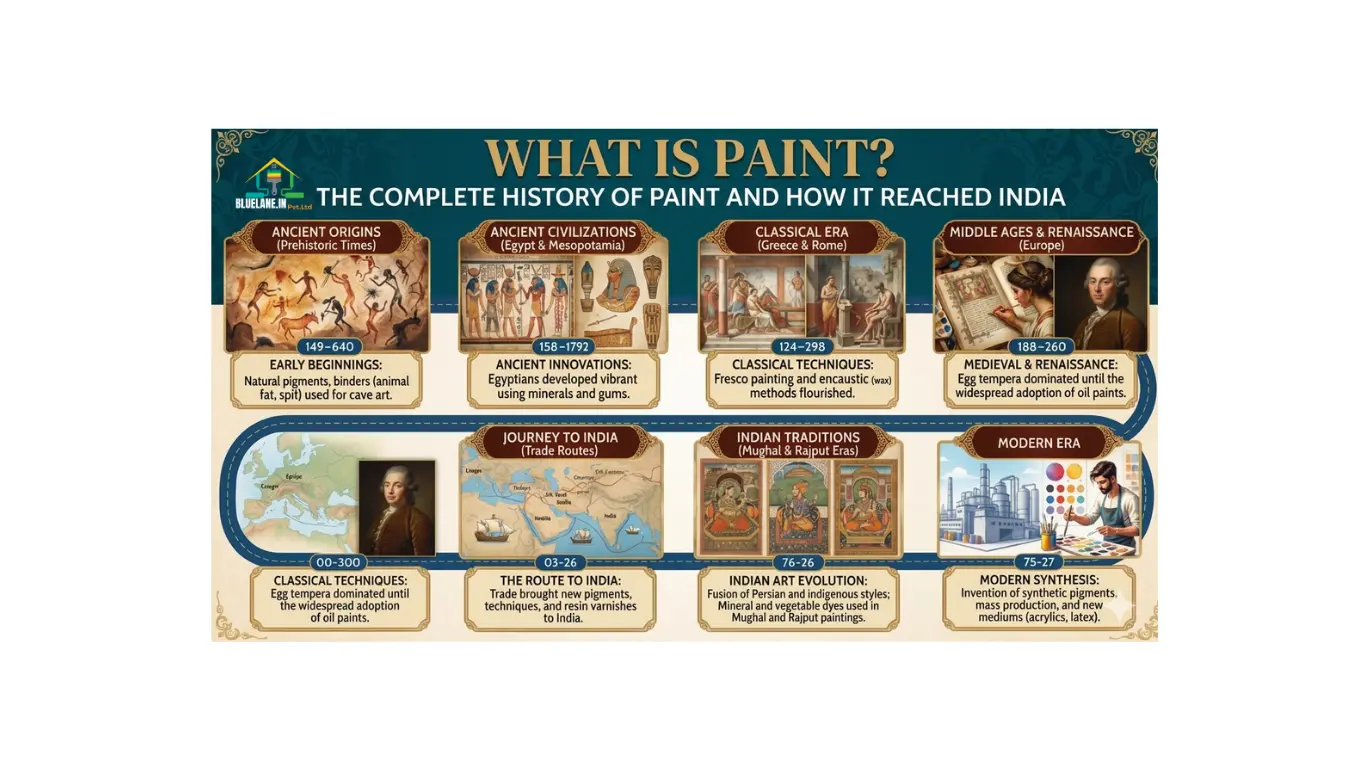
What Is Paint? The Complete History of Paint and How It Reached India | BlueLane Painting
The Story of Paint: From Ancient Civilizations to Modern Homes in India
When you look at the colourful walls of a modern home, it is easy to think of paint as just another building material. In reality, paint is one of humanity's oldest inventions. Long before cities, skyscrapers, and modern homes existed, people used natural colours to communicate ideas, decorate shelters, and preserve history. Today, professional painting has evolved into a science that combines aesthetics, protection, and technology.
At BlueLane Painting & Home Solutions Pvt. Ltd., we believe that understanding the history of paint helps us appreciate how far this remarkable craft has come.
What Is Paint?
Paint is a protective and decorative coating applied to a surface. It is made by combining pigments, binders, solvents, and additives.
Each ingredient plays a specific role:
- Pigments provide colour and hiding power.
- Binders help the paint adhere to surfaces.
- Solvents keep the paint in liquid form until it dries.
- Additives improve durability, weather resistance, drying time, and finish.
Modern paints not only enhance appearance but also protect buildings from moisture, sunlight, dust, fungi, and corrosion.
When Did Humans First Start Using Paint?
The history of paint stretches back more than 40,000 years. Archaeologists have discovered prehistoric cave paintings in Europe, Indonesia, Australia, Africa, and other parts of the world.
Early humans created colours using materials found in nature, including:
- Charcoal
- Red and yellow ochre
- Clay
- Limestone
- Animal fat
- Plant extracts
These natural pigments were mixed into a paste and applied using fingers, animal hair, feathers, or hollow reeds.
Rather than decorating homes, these early paintings told stories, recorded hunting scenes, and expressed spiritual beliefs.
Unlike many modern inventions, paint developed gradually across different civilizations. Ancient communities independently discovered ways to make coloured coatings from locally available minerals and natural materials.
Some of the civilizations that contributed significantly to the development of paint include:
- Ancient Egyptians
- Mesopotamians
- Greeks
- Romans
- Chinese
- Indians
Each culture improved paint-making techniques, introducing new pigments, binders, and decorative styles that influenced future generations.
How Paint Evolved Through History
Ancient Egypt
The Egyptians transformed paint into an art form. Around 3000 BCE, they developed stable mineral pigments and used them extensively in temples, tombs, sculptures, and monuments.
Many colours found inside Egyptian pyramids remain visible even after thousands of years, demonstrating remarkable craftsmanship.
Ancient Greece and Rome
Greek and Roman builders used paints for architecture, public buildings, and sculptures. They experimented with lime-based coatings and natural minerals that improved durability.
They also introduced decorative wall finishes that inspired many modern interior painting techniques.
China
Chinese craftsmen developed sophisticated lacquer coatings made from tree resin. These coatings protected wood while producing a glossy, durable finish.
Their innovations influenced furniture finishing and decorative arts across Asia.
How Paint Reached India
India has its own rich history of painting that dates back thousands of years. Rather than paint arriving from one country, Indian civilizations developed their own techniques while also adopting new ideas through trade and cultural exchange.
Some of the earliest examples include:
Prehistoric Rock Art
The famous rock shelters of Bhimbetka in Madhya Pradesh contain paintings estimated to be thousands of years old. These artworks depict hunting, dancing, animals, and everyday life using natural pigments made from minerals and plant materials.
Ancient Indian Civilizations
Indian artisans decorated temples, palaces, caves, and homes using lime washes, mineral colours, and natural dyes.
Historic sites such as the Ajanta and Ellora Caves showcase extraordinary murals created with remarkable precision and artistic skill.
Medieval India
As trade expanded across Asia and the Middle East, India adopted additional pigments and painting techniques. Decorative painting became an important part of architecture during various dynasties.
The British Era
Modern industrial paints became widely available in India during the nineteenth century. Advances in manufacturing introduced oil-based paints, followed later by synthetic paints suitable for homes, offices, factories, and public buildings.